Tag: Oil

  • High fuel prices in the U.S. may crimp oil demand soon

    High fuel prices in the U.S. may crimp oil demand soon

    By Garrett Golding

    Oil prices have surged, with benchmark West Texas Intermediate (WTI) crude jumping from an average of $71 per barrel in December 2021 to $109 in May 2022. U.S. inventories of gasoline and diesel are running low and refining capacity is strained, while export demand remains strong.

    Gasoline and diesel prices in the U.S. are at record levels on a nominal (non-inflation-adjusted) basis (Charts 1, 2).

    Much market commentary has focused on oil prices remaining far from record levels in real (inflation-adjusted) terms. WTI oil prices averaged $128 per barrel in July 2008, which in real terms is $169 today.

    However, consumers buy refined products, not crude oil.

    The monthly national average for regular-grade gasoline, which reached $4.46 per gallon in May, is far below the 2008 peak of $5.35 in real terms, and gasoline prices between 2011 and 2014 were consistently at or above recent, early-summer levels.

    Though daily national average prices recently eclipsed $5 a gallon, prices could still rise much higher if one believes consumers experienced and, to some extent, withstood such prices before.
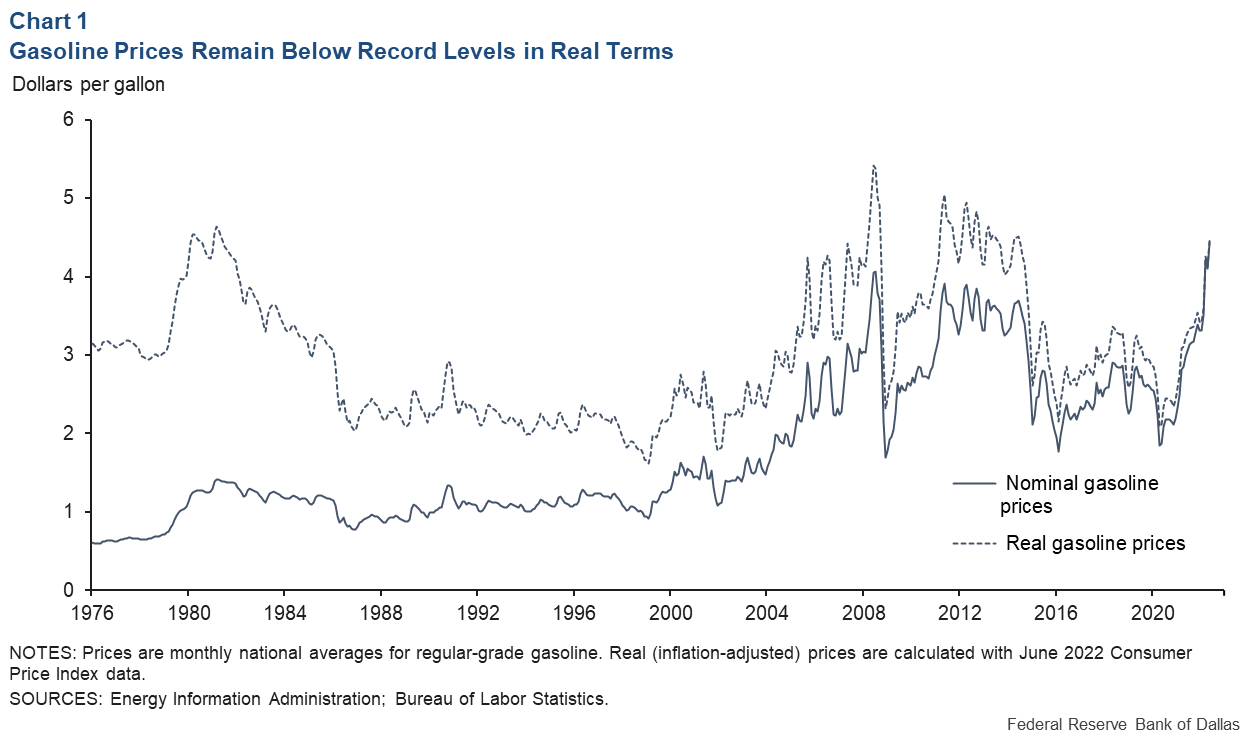
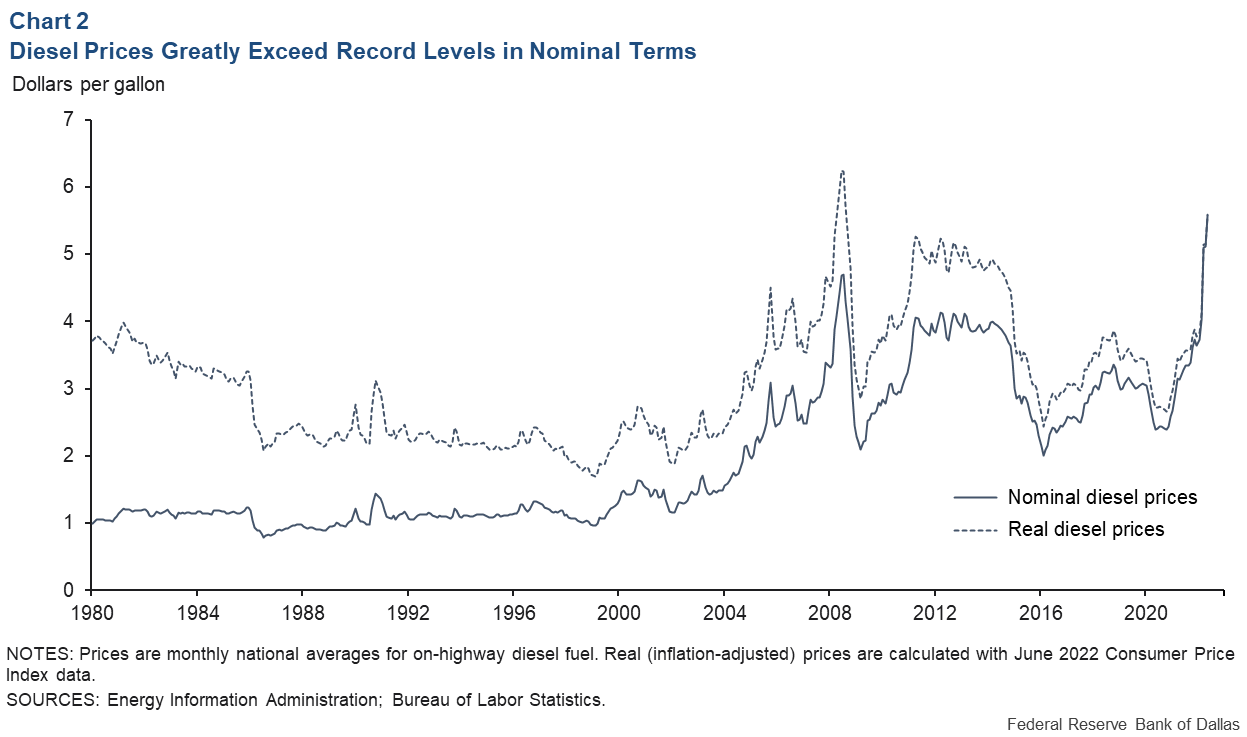
    Chart 1: Gasoline Remains Below Record Prices in Real Terms

    Downloadable chart | Chart data

    Chart 2: Diesel Prices Exceed Record Levels in Nomiinal Terms

    Downloadable chart | Chart data

    There are complications, though—inflationary pressures unrelated to fuel prices, declining real wages and the magnitude of this latest price shock.

    Additionally, a larger price spread between refined products and crude oil, particularly diesel, has amplified the impact of this shock relative to previous episodes.

    These factors raise questions about whether U.S. fuel consumption can withstand higher prices for much longer.

    Without an adequate supply response arriving in the near term from either crude oil production or refining capacity, demand destruction is likely the only variable that can eventually cause the fuel price surge to slow and reverse.

    Fuel Has Low Price Elasticity of Demand

    U.S. consumers historically only slowly reduce fuel consumption as prices increase. This is primarily because most consumers must drive to work, school, grocery stores, and other destinations every day.

    Additionally, there are no scalable alternatives that can be immediately substituted. Using public transportation is an alternative mainly for those in dense urban areas, and buying a more fuel-efficient or electric vehicle at the first sign of higher pump prices is not an option for most.

    Because of this, fuel demand is referred to as price inelastic, meaning as the price for the product increases, the quantity demanded decreases at a slower rate in percentage terms. For a price-elastic item, the quantity demanded would fall at the same rate or faster than the price increase.

    With a supply-driven price shock like the current one, there is a risk due to price inelasticity that fuel prices could reach a level where consumers cut spending on other items, posing a risk to the broader economy.

    Consumer Memories Are Short

    Though fuel prices have been much higher on an inflation-adjusted basis, consumers are unlikely to reference what they paid for fuel 10 years ago as a benchmark for current household budgeting.

    Vehicle purchases, work, and commuting choices, and travel plans are made with more recent prices in mind.

    Consider someone who purchased a vehicle in December 2020, when gasoline prices averaged just $2.20 per gallon. Consumers tend to expect fuel prices to remain at or near that level during their ownership period.

    The longtime best-selling vehicle in the U.S., the Ford F-150, has a combined fuel economy rating of 20 miles per gallon in its V-6 configuration for late-model years.

    With Americans driving an average of 13,474 miles in 2021, the F-150 owner’s annual fuel bill at $5 a gallon will rise $1,886, or about $157 each month, if the miles driven do not change.

    Put another way, for a U.S. worker in the first quartile of income (the lowest 25 percent), 9 percent of earnings would go toward gasoline purchases now versus 4 percent a little more than a year earlier.

    Problematic Price Premium for Diesel

    Distillates—the class of refined products that includes diesel, home heating oil, and jet fuels—are in short supply globally and subject to surging prices. U.S. diesel prices have jumped 53 percent since December, while gasoline is up 34 percent.

    The main culprits: a reduction in U.S. refining capacity since the COVID-19 downturn in 2020, and the global scramble since February to replace sanctioned Russian diesel exports and crude oil (which renders more distillate than other types of crude oil).

    The spread between on-road diesel and WTI prices has never been higher (Chart 3). At the current spread, diesel would average $7 per gallon nationally—well above the $5.57 average in May 2022—if WTI were to rise to $169 per barrel, the inflation-adjusted peak in 2008.
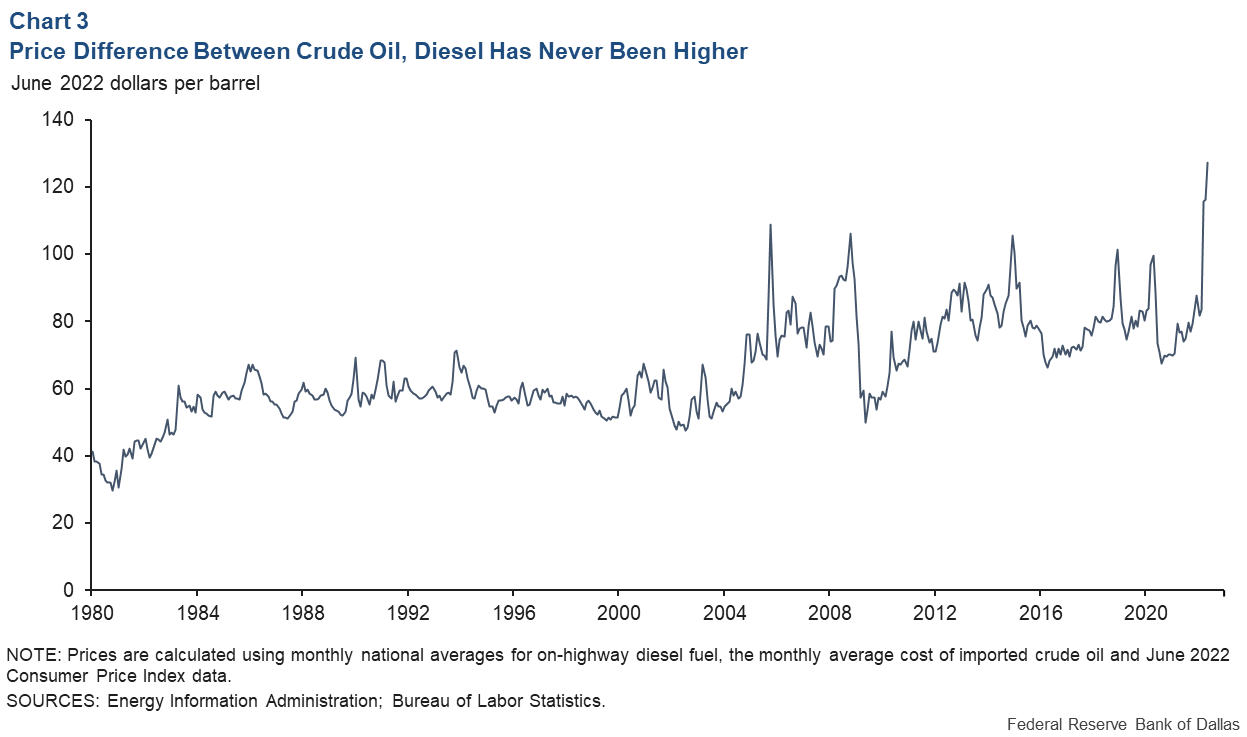
    Chart 3: Price Difference Between Crude Oil, Diesel Has Never Been Higher

    Downloadable chart | Chart data

    This price surge is most acutely felt by freight and agricultural end users, increasing the cost of bulk transportation, deliveries, and food production.

    For a farmer who plants and harvests 1,000 acres of corn this year using conventional tilling, at an average of 5 gallons of diesel per acre, the fuel bill for that crop would be $27,500 today versus $16,400 in 2021.

    Fuel Prices Not the Only Inflationary Pressure

    The additional fuel expenditures might not be a problem if income growth were commensurate. However, wages have failed to keep pace with inflation since the second quarter of 2020. As a result, real earnings have declined at a pace not seen since 1979–81 (Chart 4).
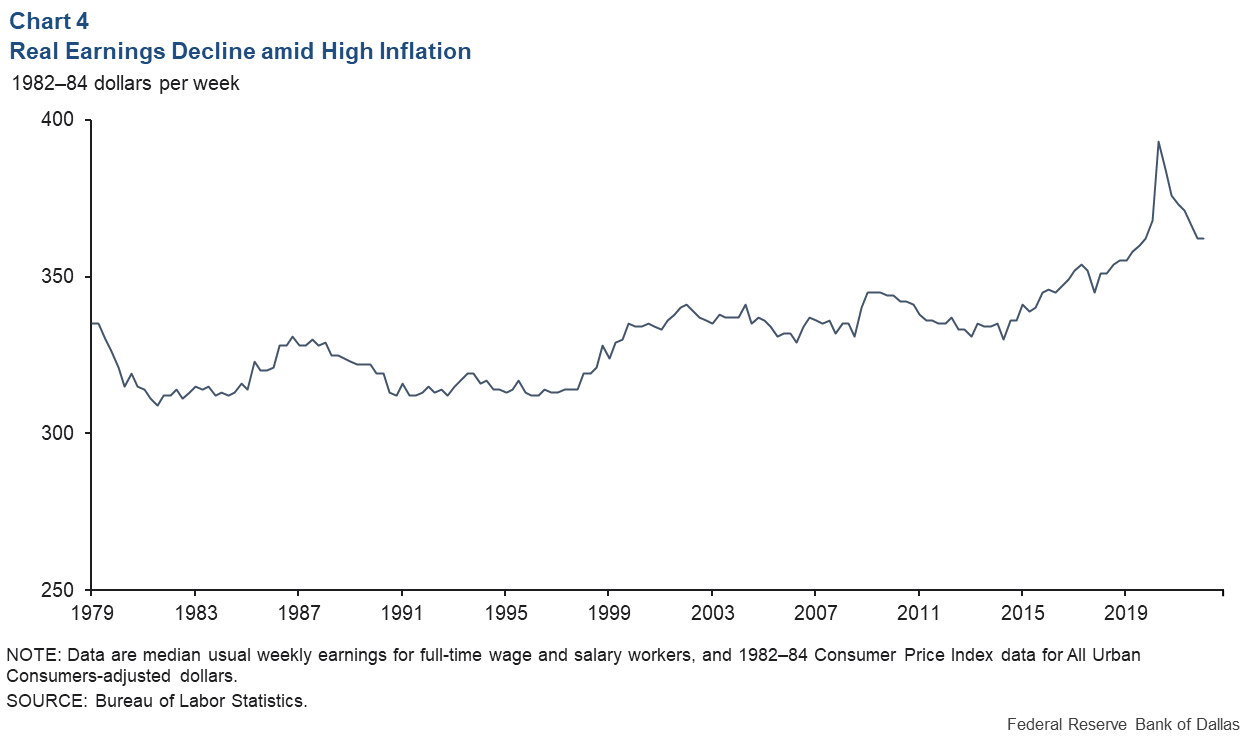
    Chart 4: Real Earnings Decline Amid High Inflation

    Downloadable chart | Chart data

    Although real earnings are higher than during earlier episodes of high fuel prices, there is little room in most household budgets, particularly for those in the lowest quartile of income, to accommodate a 50 percent jump in fuel costs.

    The rapid decline in the personal savings rate over the past year could be considered evidence of tighter budgets.

    U.S. Fuel Consumption Bending, Not Breaking

    Still, U.S. fuel consumption has shown resilience. There has been no abrupt drop in today’s elevated prices. Gasoline demand has so far only come in below seasonal norms, while diesel consumption has trended lower after a strong start earlier in the year (Charts 5, 6).
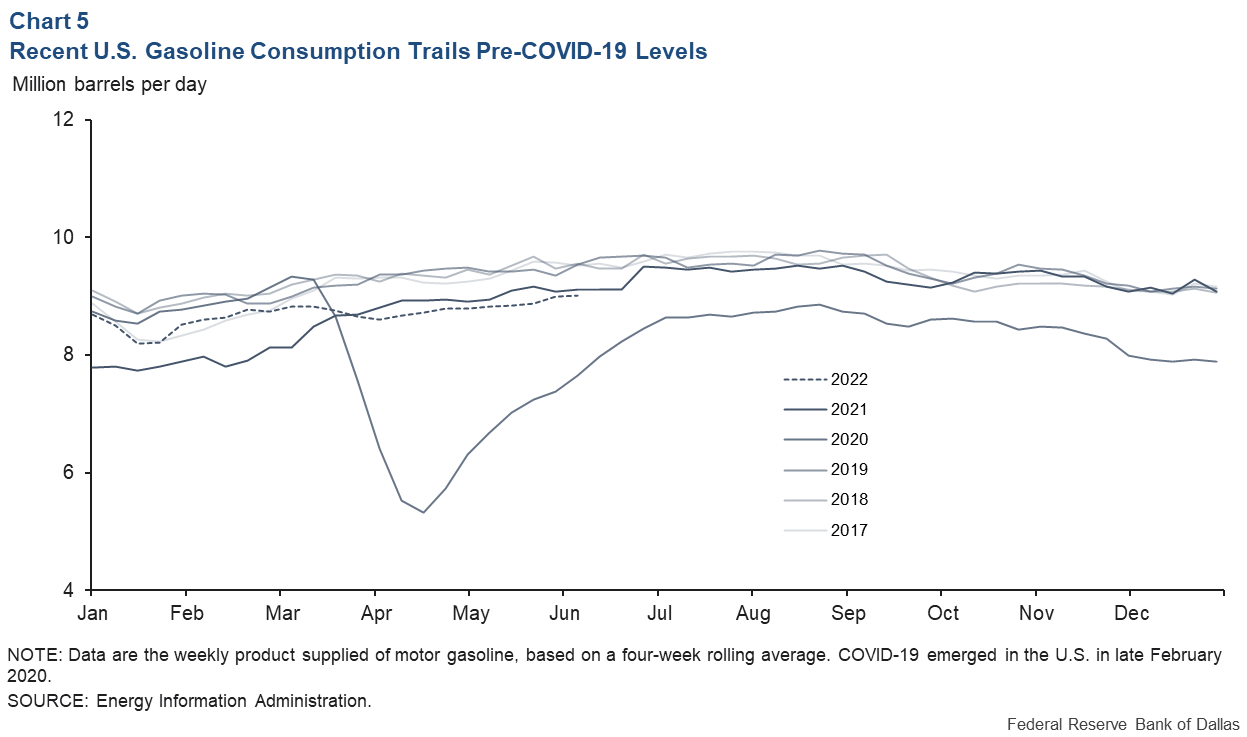
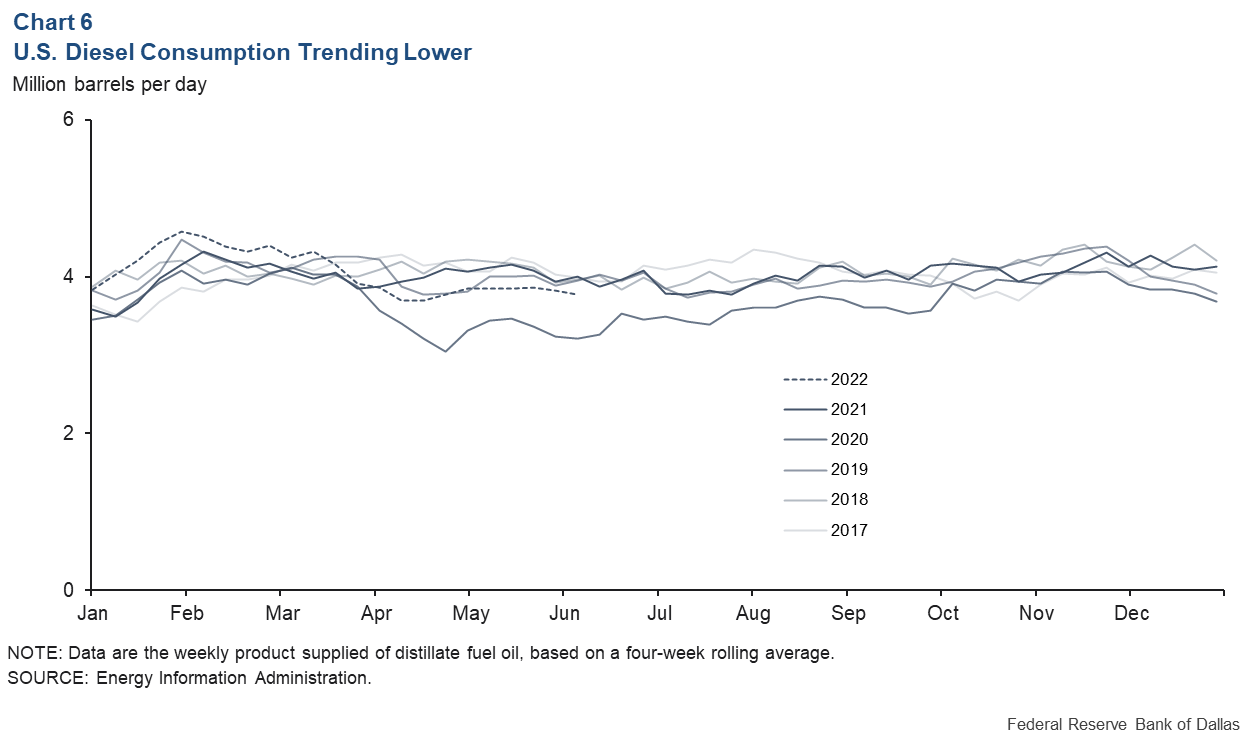
    Chart 5: Recent U.S. Gasoline Consumption Trails Pre-COVID-19 Levels

    Downloadable chart | Chart data

    Chart 6: U.S. Diesel Consumption Trending Lower

    Downloadable chart | Chart data

    Pent-up demand for travel (particularly foreign travel) amid easing COVID-19 restrictions could be a reason U.S. fuel consumption remains sticky. This may provide only a temporary uplift through August when the summer travel season winds down.

    At the same time, a proliferation of work-from-home options gives many workers the ability to reduce their commuting fuel use—which is roughly 30 percent of gasoline consumption—relative to pre-COVID-19 levels.

    A continuation of the work-from-home trend could help reduce fuel demand and increase price elasticity going forward, though it is too early to fully assess the impact. Complicating matters are lower-wage workers, who are the least likely to have work-from-home options and are the most challenged by high fuel prices.

    All told, fuel prices may be closer to consumers’ pain threshold than inflation-adjusted prices might suggest. And if prices climb higher, expect consumers to respond by cutting back on fuel consumption and overall spending sooner than later.

    PDF SLIDESHOW

    https://drive.google.com/file/d/1AxXNQKd9B2NlQ3XB5r-V0o5rykuD_oUg/view?usp=sharing

    Source: Federal Reserve Bank of Dallas.
  • Four Texas Democrats in Congress warn Biden against restricting U.S. oil exports

    Four Texas Democrats in Congress warn Biden against restricting U.S. oil exports

    By Patrick Svitek

    This story was originally published by the Texas Tribune.

  • Op-Ed: Joe Biden’s progressive energy agenda is soaring prices

    Middle class Americans don’t need an economist or political scientist to tell them there’s something wrong with the economy. They realize it every time they put gas in their tanks or have to pay more for groceries.

    The financial security of many families is now in jeopardy because the Biden Administration cares more about appeasing radical environmentalists rather than securing America’s energy independence.

    It didn’t have to be this way. Under the previous Administration, the United States was essentially energy independent.

    That all changed, however, on January 20, 2021, with the Biden Administration’s unlawful recession of domestic energy production on multiple fronts; and it has further deteriorated throughout his first year in office and into this worldwide chaos centering on the Russian War in Ukraine.

    Unfortunately, the Biden Administration refuses to restart the energy independence it inherited. On its first week in office, it halted all new oil and gas leases on federal lands, which federal courts held was unlawful.

    Then, after sanctioning importation of Russian oil, liquefied natural gas, and coal to the United States, a White House delegation traveled to Venezuela to discuss “energy security,” according to former Press Secretary Jen Psaki. But the United States should never be dependent on murderous thugs or despotic regimes for its energy needs.

    President Biden remains beholden to leftwing climate activists, which is why he is vigorously opposing a return to successful energy policies.

    Many of these radicals, who are now influencing or directing energy policies, are actively hampering production from private companies through market manipulation or allocation based on investment firm imposed environmental, social, or governance (ESG) factors. That’s why our office has launched an investigation of this potentially unlawful behavior.

    There are many imprudent extreme energy policies of the Biden Administration, and the list continues to grow as this crisis broils into a catastrophe.

    President Biden revoked a key permit to the Keystone Pipeline, ceased drilling for oil in Alaska, ballooned the “social cost of carbon,” and paused new oil and gas leases.

    With a legacy like this on such a vital component of a functioning nation, it’s no wonder why Americans are being financially devastated at the gas pumps.

    Though energy production is largely a federal matter, many states, like Arizona, have stepped up to use our tools to mitigate this Administration’s harmful actions and to hold it accountable to the rule of law.

    Our office has taken numerous actions to challenge the Biden Administration’s sabotage of domestic energy production. We joined a challenge to the Administration’s “Social Cost of Carbon” regulations, which are employed to limit energy production.

    We similarly filed suit to challenge the Administration’s cancellation of the Keystone Pipeline. We opposed the Biden Administration’s attempt to repeal rules allowing for transportation of liquid natural gas by rail, that expands the access of U.S. citizens to the energy production of our own nation.

    Americans deserve a president who is defending their interests and upholding the rule of law. Tragically for Americans, Biden and his bureaucratic henchmen appear poised to double down on their radical energy policies to appease the chorus of fanatical special interest groups.

    And it is particularly pernicious that this Administration’s lawlessness in the United States may be used to subsidize the lawless and brutal repression of the people of Venezuela.

    Mark Brnovich is an American attorney and politician who has served as the 26th Attorney General of Arizona since 2015.

  • Nearly $5 billion in production taxes paid by Texas oil and natural gas industry to date this fiscal year

    Nearly $5 billion in production taxes paid by Texas oil and natural gas industry to date this fiscal year

    By Bethany Blankley | The Center Square

    Texas oil producers paid a record $666 million to the state in oil production taxes in April – the highest amount in history, representing a 99% increase from April 2021.

    The monthly amounts of tax revenue paid by the industry in the past two months alone exceed the total amount of revenue the industry has paid for an entire year in previous years, according to new data from the state comptroller’s office.

    Natural gas producers paid $339 million in taxes, up 46% from April 2021.

    Combined, the oil and natural gas industry paid $1.005 billion in production taxes in April.

    In May, oil producers paid $595 million in taxes, an increase of 64% from May 2021. Natural gas producers paid $413 million in taxes, the highest monthly total on record, up 216% from May 2021.

    Combined, the industry paid $1.008 billion in production taxes in May.

    “The state’s natural gas production tax revenue was an all-time high in May,” the Railroad Commission of Texas, which regulates the industry, said in a statement. “That revenue helps fund education, transportation, and other parts of the state budget.”

    If Texas were its own country, it would be the world’s third largest producer of natural gas and fourth largest producer of oil.

    In May alone, the Texas Railroad Commission issued 963 drilling permits, it said.

    That’s opposite of the Biden administration, which banned new oil and gas leases on federal lands on the president’s first day in office, negatively impacting some states’ revenue and contributing to record high gas prices and 40-year inflation.

    Unlike other states where production is dependent on federal leases, oil and natural gas production primarily occur in Texas on privately owned land.

    “Tax revenue generated by robust oil and natural gas activity across Texas continues to be a game-changer for Texans, providing billions of dollars in funding for our state’s public schools and universities, roads, first responders, and essential services,” Todd Staples, president of the Texas Oil & Gas Association, said in a statement. “The indispensable role this industry plays in Texas’ continued economic successes underscores the importance of policies that encourage responsible development of our natural resources.

    “No one produces the oil and natural gas the world needs in a more environmentally responsible way than American producers, and the lion’s share of that production takes place right here in Texas,” Staples added.

    The comptroller’s office published tax revenue the state collected from the industry in April and May of this year.

    In fiscal 2021, which ended Aug. 31, oil production tax revenue totaled $3.45 billion, the second highest in Texas history. The industry paid the greatest amount of taxes in fiscal 2019 at $3.89 billion.

    Now, the industry is on track to exceed these amounts in fiscal 2022. With three months left in the fiscal year, it’s already paid a record $4.48 billion in taxes.

    Natural gas production tax revenue alone, in the first nine months of fiscal 2022, has already exceeded revenue totals of all fiscal years in history as of May by $2.97 billion. The next highest amount of taxes the industry paid was in fiscal 2008 at $2.68 billion.

    Employment in the oil and natural gas industry continues to grow, with an average of 3,950 upstream jobs added every month this year. Since the low point in employment in September 2020, 33,400 upstream jobs have been added in Texas, with job growth months outnumbering decline months by 17 to 2.

    In fiscal 2021, the industry directly employed over 422,000 Texans with jobs that pay among the highest wages in the state.

    “For every direct job, an additional 2.2 indirect jobs are created elsewhere in the economy, which means you don’t have to be employed by the oil and natural gas industry to benefit from the tremendous economic prosperity and opportunities the industry brings Texas,” Staples said.

    These taxes exclude other taxes the industry also pays, including billions in property taxes on all assets producing minerals, in addition to properties housing pipelines, refineries, and gas stations.

    The industry also pays billions more in state and local sales taxes, franchise taxes, gross receipts taxes imposed on natural gas utilities and pipelines, and millions of dollars in additional fees imposed by the state.

  • State sales tax revenue totaled $3.7 billion in May

    State sales tax revenue totaled $3.7 billion in May

    AUSTIN — On Wednesday, Texas Comptroller Glenn Hegar said state sales tax revenue totaled $3.69 billion in May, 8.6 percent more than in May 2021.

    Annual revenue growth of 8.6 percent suggests modest growth in underlying taxable economic activity, in view of the current inflationary environment with Consumer Price Index inflation at 8.3 percent in April.

    The majority of May sales tax revenue is based on sales made in April and remitted to the agency in May.

    “Strong, double-digit growth was seen once again in sectors driven primarily by business spending, with receipts from the oil and gas mining sector continuing to exhibit particularly robust growth compared to a year ago,” Hegar said. “Receipts from the construction and wholesale trade sectors also continue to show strong growth.

    “Receipts from the services sector posted another substantial gain compared to the same month last year. Spending at sporting events and concerts was especially strong last month as consumers continue to spend more on live entertainment after being restricted during the pandemic. Receipts from restaurants also increased compared to May 2021.

    “Increases in these consumer-driven sectors, coupled with a decrease in receipts from the furniture and general merchandise sectors compared to a year ago, may further indicate that sectors that benefited from pandemic spending patterns will face continued headwinds due to a shift in consumer spending patterns from goods to services.”

    Total sales tax revenue for the three months ending in May 2022 was up 15.7 percent compared to the same period a year ago. Sales tax is the largest source of state funding for the state budget, accounting for 59 percent of all tax collections.

    Texas collected the following revenue from other major taxes:

    • motor vehicle sales and rental taxes — $603 million, up 9 percent from May 2021;
    • motor fuel taxes — $319 million, up 1 percent from May 2021;
    • oil production tax — $595 million, up 64 percent from May 2021;
    • natural gas production tax — $413 million, the highest monthly collections on record, up 216 percent from May 2021;
    • hotel occupancy tax — $69 million, up 44 percent from May 2021; and
    • alcoholic beverage taxes — $154 million, the highest monthly collections on record, up 22 percent from May 2021.

    Fiscal 2022 franchise tax collections totaled $5.16 billion year-to-date through May. Last year, the reporting deadline was deferred to June from the usual May 15 due date. Compared to collections through June 2021, year-to-date franchise tax collections were up 21.6 percent.

  • Don’t look to oil companies to lower high retail gasoline prices

    Don’t look to oil companies to lower high retail gasoline prices

    Garrett Golding and Lutz Kilian

    The rise of U.S. retail gasoline prices in March 2022 has triggered a debate about whether U.S. oil companies are doing enough to rein in high gasoline prices and whether these companies should be held accountable for not increasing the production of crude oil.

    We take a closer look at the premises underlying this debate. We show that, even though the price of oil makes up over half of the retail price of gasoline, oil companies play an extremely limited role in how retail gasoline prices are set.

    While U.S. retail gasoline prices in many regions have remained stubbornly high since March, this situation reflects frictions in the retail gasoline market rather than the supply of oil or the price of oil.

    We discuss why, in many regions, pump prices have not fallen as quickly as oil prices have recently and explain why this asymmetry need not be an indication of price gouging.

    Finally, we examine the obstacles to substantially increasing U.S. oil production. We make the case that even under the most favorable circumstances, higher production growth is unlikely to materially lower global oil prices—and, thus, U.S. retail gasoline prices—in the foreseeable future.

    Gasoline Retailing Involves a Complex Supply Chain

    Before a gallon of gasoline is pumped into a car’s tank, it has traveled through a complex supply chain.

    Independent oil and gas companies—those without refining assets—are responsible for 83 percent of U.S. oil production and about half of the oil consumed in this country. Oil is sold in competitive markets at prices reflecting global supply and demand. It is refined into gasoline, diesel, and other fuels whose prices are similarly set in competitive markets.

    Fuels are then sent to more than 400 U.S. distribution facilities, from which they are sold and delivered to retailers and end users at another price depending on local conditions.

    Gas station operators set retail prices based on their expected acquisition cost for the next delivery of fuel from the local distributor, federal and state tax rates, and a markup that covers operating expenses, such as rent, delivery charges, and credit card fees.

    Since only 1 percent of service stations in the U.S. are owned by companies that also produce oil, U.S. oil producers are in no position to control retail gasoline prices.

    How the Cost of Oil Feeds into the Gasoline Price

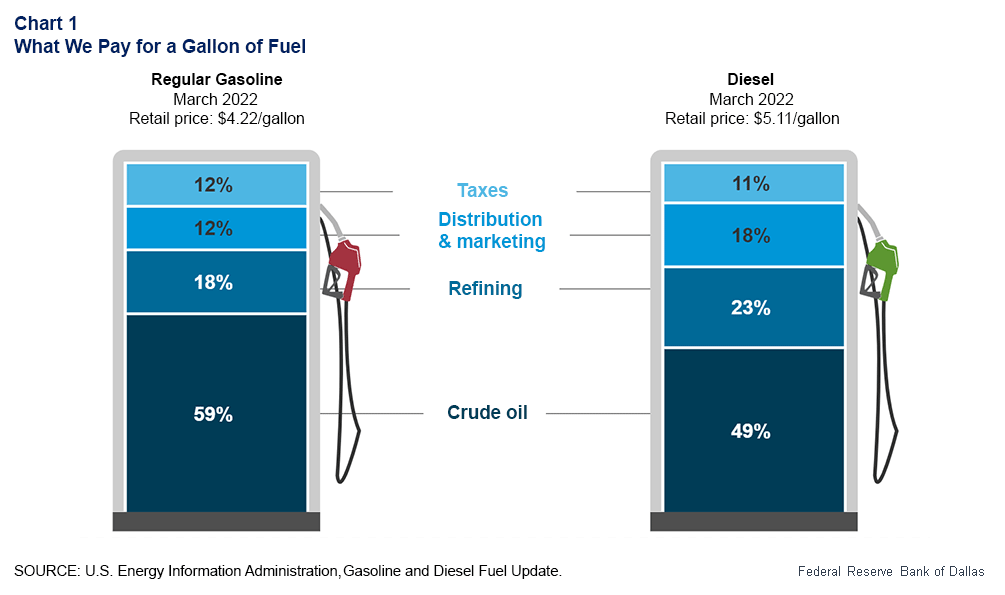
    The price of oil constituted 59 percent of the retail price of gasoline in March 2022, according to the Energy Information Administration (Chart 1).

    Chart 1: What We Pay for a Gallon of Fuel

    This fact is important for understanding the transmission of oil price shocks to retail gasoline prices.

    Gasoline’s Slow Decline from Price Peak Not a Sign of Price Gouging

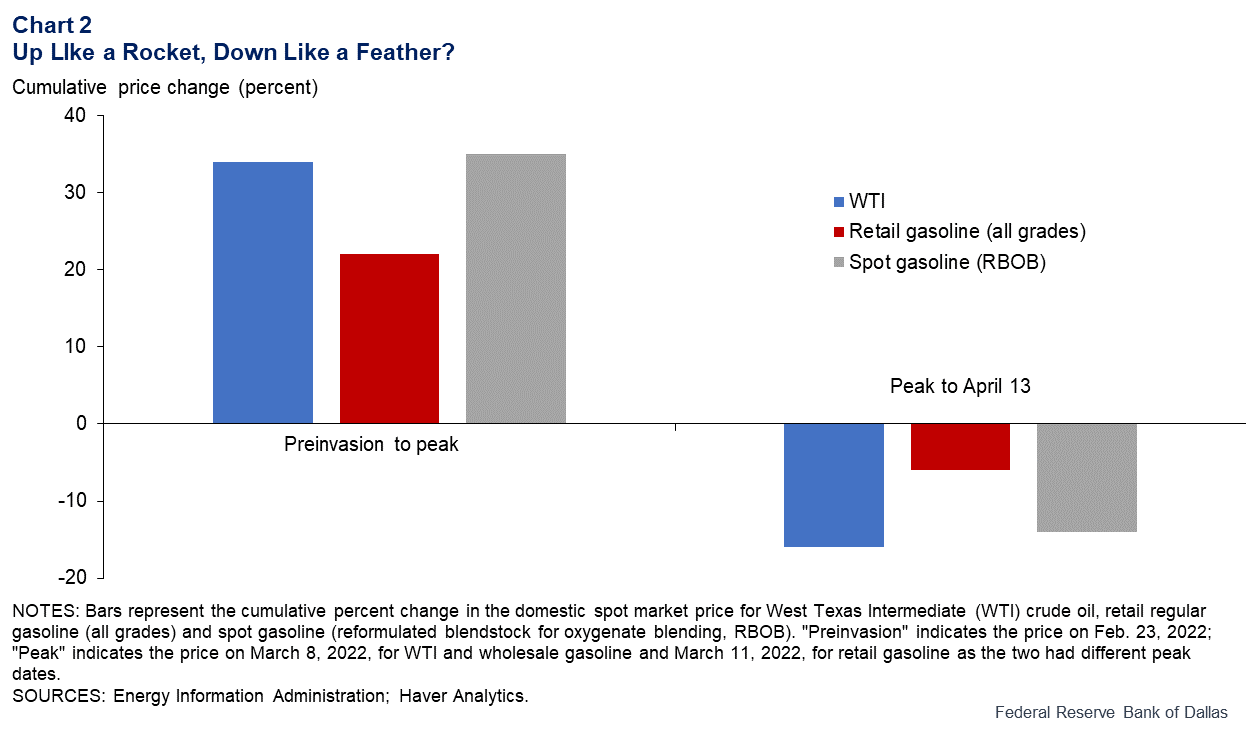
    Much has been made of the fact that gasoline prices were quick to increase following the Russian invasion of Ukraine but have not come down as quickly as the price of crude oil since then (Chart 2).

    Chart 2: Up Like a Rocket, Down Like a Feather?

    Given that crude oil accounts for 59 percent of the cost of gasoline, a 34 percent increase in the price of oil should imply a 20 percent increase in the retail gas price. Likewise, a 22 percent decline in the price of oil should translate to a 13 percent decline in the pump price. However, that did not happen at the national level.

    As Chart 2 shows, the spot price of gasoline (the price of gasoline at the refinery gate), as proxied by the prompt contract for New York Mercantile Exchange RBOB gasoline, generally rose and fell with the price of West Texas Intermediate crude oil.

    However, the response of U.S. pump prices has been highly asymmetric. While the price of retail gasoline cumulatively rose about as much as expected following Russia’s invasion of Ukraine, recent national retail gasoline prices dropped only 6 percent from the March peak, far less than the expected 13 percent.

    This indicates that retail gasoline prices remaining persistently high was not the result of an oil shortage or high oil prices. Rather, the elevated retail gasoline prices must be attributed to events in the U.S. retail gasoline market beyond the control of oil producers.

    Moreover, the asymmetry of the response of retail gasoline prices need not be evidence of price gouging. One potential explanation is that station operators are recapturing margins lost during the upswing when gas stations were initially slow to increase pump prices.

    The reluctance to lower retail prices also likely reflects concerns that oil prices—and, hence, wholesale gasoline prices—may quickly rebound, eating into station profit margins.

    Another possible reason for this asymmetry is consumers’ tendency to more intensively search for lower pump prices as gasoline prices rise than when they decline. This diminished search effort provides further pricing power to gas stations, causing prices to fall more slowly than they rose.

    This has prompted researchers to liken the response of gasoline prices to higher oil prices to a rocket—and the response to lower oil prices to a feather.

    Yet another potential explanation for this asymmetry is that seasonal demand tends to increase as the weather warms, supporting higher retail prices.

    Prices Don’t Uniformly Change Across the Country

    Interestingly, retail gasoline price responses have not been uniform across the country. In Dallas, for instance, retail prices fell at a pace that indicated a symmetric price adjustment.

    In contrast, prices in Phoenix are virtually the same as they were when the national retail average price peaked on March 10 (Table 1).

    Table 1: Retail Price Changes Can Vary Across Regions

    City Feb. 23 March 10 (peak) Percent change April 10 Percent change (from peak)
    Dallas $3.26 $4.08 25.15 $3.60 -11.76
    Phoenix $3.78 $4.63 22.49 $4.64 0.22
    SOURCE: Gas Buddy. Federal Reserve Bank of Dallas

    In the case of Phoenix, which is served by Southern California oil refineries, an unexpected refinery outage in early March prompted higher regional wholesale fuel prices just as prices elsewhere in the country started to fall.

    This suggests that price-reduction policies that treat all regions of the country the same are unlikely to be effective at curing the root causes of the asymmetry in the aggregate retail price response.

    Oil Producers Face Difficulties Increasing Production

    Consumers and policymakers often ask what domestic oil producers can do to raise output and lower gasoline prices, especially since producers’ profitability has greatly improved in 2022.

    Because the price of crude oil is determined in global markets, increases in domestic oil production affect the retail price of gasoline only to the extent that they lower global oil prices.

    Many observers point out that oil companies currently hold nearly 9,000 permits to drill on federal lands. But holding 9,000 permits does not equate to 9,000 well locations that are worth drilling, nor would it be possible to churn through that much inventory in a reasonable time frame.

    Data provider Enersection found that since 2015, an average of 1,560 wells have been drilled on federal lands annually, but only 47 percent of federal permits issued were actually utilized.

    This is because companies tend to acquire permits on the acreage they lease even if they are not certain whether the location is worth developing.

    The latest Dallas Fed Energy Survey shows that investor pressure to maintain capital discipline—which precludes higher investment in expanding oil production—is the primary restraint on publicly traded companies.

    This is not simply a case of investors being selfish, but of investors who suffered persistent losses in years past wanting compensation for the risk they take.

    Depriving these investors of the returns they insist on, by whatever means, would likely be counterproductive because, without these investors, the industry would lack the capital to maintain—never mind, increase—crude production going forward.

    Additionally, producers and service companies are constrained by labor shortages, rising input costs, and supply-chain bottlenecks for vital equipment such as well casing and coiled tubing.

    An industry that lacks experienced staff and materials cannot on short notice substantially increase drilling and production.

    Complicating matters, many shale producers are running low on top-quality drilling locations. Thus, it would be unreasonable to expect a noticeable increase in oil production before 2023 at the earliest, even if investors were to agree to higher production targets.

    Higher U.S. Oil Production Might Not Lower Retail Gasoline Prices

    Apart from the difficulties of expanding domestic oil production, what are the odds of higher U.S. oil production growth materially lowering the prices of crude oil and gasoline?

    Even under the most optimistic view, U.S. production increases would likely add only a few hundred thousand barrels per day above current forecasts.

    This amounts to a proverbial drop in the bucket in the 100-million-barrel-per-day global oil market, especially relative to a looming reduction in Russian oil exports due to war-related sanctions that could easily reach 3 million barrels per day.

    Placing the responsibility to lower retail gasoline prices on shale oil producers is thus unlikely to work, and additional regulation of oil producers is unlikely to lower pump prices.

    Source: The Federal Reserve Bank of Dallas

  • Biden administration cancels new oil leases as gas prices hit record highs

    Biden administration cancels new oil leases as gas prices hit record highs

    By Casey Harper | The Center Square

    President Joe Biden canceled three pending oil and gas drilling leases in Alaska and the Gulf of Mexico this week as gas prices hit record highs.

    Biden has taken heavy fire for blocking new leases and pipelines as energy costs have surged but has defended his record. This latest development intensified that criticism.

    “It’s day 477 of the Biden administration, we have record gas prices, and they have still not leased one acre of land to drill oil,” Rep. Dan Crenshaw, R-Texas, said.

    The Department of Interior announced the decision late Wednesday, saying there was not enough industry interest in the areas.

    Experts argue the Biden administration’s fight to cancel all oil and gas leasing has made it risky and unappealing for the oil and gas industry to begin new investments in the U.S. The Alaska lease had difficulty receiving interest at certain points in the past before Biden took office.

    “Canceling oil and gas leases is part of Biden’s ongoing punishing of the industry including threatening banks for lending and investment,” said Daniel Turner, executive director of the energy workers advocacy group, Power the Future. “We are all living the consequence: outrageously high prices and growing shortages.”

    The decision comes just days after the U.S. hit record high gas prices. According to AAA, the national average gas price is currently $4.42, up from $3 per gallon the same time last year, when prices had already begun to rise.

    Federal inflation data released Wednesday also showed a slight decline in energy costs in April but still overall a major increase in energy prices in the past year.

    Biden blocked all new oil and gas leasing on federal lands via executive order shortly after taking office, but a federal judge overturned that decision.

    Earlier this week, the White House defended Biden’s work on energy costs.

    “He’s also taken steps that are definitely smaller but meant to do anything possible, including issuing a waiver for E15 so that thousands of pumps in the Midwest could have gasoline that – and make it available to Americans so that that’s 10 cents less,” White House Press Secretary Jen Psaki said. “He also has noted … that oil companies should also do their part in ensuring they’re not price gouging customers at the pump. As oil prices come down, so should gas prices at the pump. And that’s also something that we are going to continue to watch closely and continue to call on steps to be taken.”

    Meanwhile, many Republicans blasted Biden for the decision.

    “As gas prices hit an all-time high in the USA, [the president] canceled a vital round of oil and gas lease sales this morning,” Sen. Mike Lee, R-Utah, said. “High gas prices are preventable. Democrats are putting woke politics ahead of American families.”

    They also pointed to the record high gas prices.

    “Yesterday Americans paid the highest price for gasoline in history,” Sen. Marco Rubio, R-Fla., said. “At the same time Biden just canceled our largest pending American oil [and] gas lease sale”

    Critics say Biden’s green agenda has Americans paying the price.

    “Biden has repeatedly said he is doing everything in his power to lower gas prices, but then he pushes policies like this which cripple the industry’s ability to produce,” Turner said. “It also scares off any investment. Joe Biden made it clear in his campaign that he believes fossil fuels are the enemy. By making them scare and expensive he creates a narrative to push his green agenda.”

  • North America’s first industrial scale eFuels facility to be built in Texas

    North America’s first industrial scale eFuels facility to be built in Texas

    By Bethany Blankley | The Center Square

    Another international company is making another first for Texas. This time, Highly Innovative Fuels Global, a global eFuels company headquartered in Chile, announced it’s making a $6 billiosn capital investment to build the first industrial scale eFuels facility in North America – in Texas.

    The facility will be built in Bay City in Matagorda County, just south of Houston.

    HIF’s capital investment of approximately $6 billion is expected to create approximately 3,000 direct jobs during the construction phase of the HIF Matagorda eFuels facility and more than 125 permanent operating jobs, the company says. The project is also expected to create and sustain thousands of direct and indirect jobs in the region.

    Construction of the site is expected to begin in 2023. Once completed, the facility is expected to produce eFuels by 2026.

    “As the leader in the future of eFuels, HIF will be an excellent addition to the Texas economic juggernaut,” Gov. Greg Abbott said. “This investment is great news for Texans in Matagorda County and the Coastal Bend, with more jobs, opportunity, and enhanced technology coming to the Lone Star State. Texas is proud to be the energy capital of the world, and I look forward to a continued partnership with HIF to keep our state the energy leader.”

    Abbott made the announcement in Bay City on Thursday with HIF USA CEO Renato Pereira and Matagorda County Judge Nate McDonald.

    “I am grateful to the citizens of Matagorda County for welcoming the first American eFuels facility to the south coast of Texas,” HIF USA CEO Renato Pereira said. “Once again, Texas has shown its leadership as the heart of America’s energy sector, galvanizing new energy supplies for the United States and the world.”

    He said HIF chose Texas “because of its unique combination of incentive support, available real estate, tax, and regulatory stability, and commitment to protecting the environment through responsible and sustainable economic development.”

    Matagorda County Judge Nate McDonald said that Texas “has long been the champion of energy in the United States.” The county’s economic development team and the governor’s office, he said, “have brought to fruition a new energy sector that will put Matagorda County on the map. I’m proud of the work Matagorda and HIF teams displayed throughout this process and could not be happier they selected Matagorda County for their U.S. flagship.”

    A substitute for fossil fuels, eFuels are used in cars, ships, and airplanes and require no technological modifications. HIF uses a combination of wind energy and CO2 captured from the atmosphere to create a gasoline substitute that works in existing engines and infrastructure, it explains on its website. Through a filtration process, it’s developed, HIF produces carbon-neutral gasoline by combining CO2 captured from the atmosphere with green hydrogen from renewable wind power.

    When the eFuels facility is fully operational, HIF anticipates producing approximately 200 million gallons a year of a carbon-neutral gasoline substitute that will decarbonize over 400,000 vehicles in the U.S.

    “Carbon-neutral eFuels represent the energy sector’s next frontier, enabling renewable resources to fuel our mobile economy,” Pereira said.

    HIF’s current operations are underway in Santiago and Magallanes, Chile, and Sydney, Australia.

  • State sales tax revenue totaled $3.8 billion in April

    State sales tax revenue totaled $3.8 billion in April

    AUSTIN — Texas Comptroller Glenn Hegar today said state sales tax revenue totaled $3.83 billion in April, 12.8 percent more than in April 2021.

    The majority of April sales tax revenue is based on sales made in March and remitted to the agency in April.

    “State sales tax collections reached a new high for the month of April, with double-digit growth reflecting both inflation and continued expansion in real economic activity and employment,” Hegar said. 

    “The strongest growth was in receipts from sectors driven by business spending, particularly the oil and gas mining sector, which surpassed pre-pandemic levels as capital spending in the sector picks up. Receipts from the construction, manufacturing, and wholesale trade sectors continued to show double-digit growth.

    “Among sectors driven by consumer spending, the strongest growth in receipts was in arts and recreation services, with receipts from sporting events, music and other live entertainment, and fitness clubs far exceeding previous year levels. Receipts from restaurants continued to exhibit double-digit growth as well.

    “Receipts from retail trade remain elevated, though only a little higher than a year ago when retail spending surged after the end of COVID restrictions. Slowing growth in receipts from retail trade may signal shifts in consumer spending back toward pre-pandemic patterns.

    Growth in spending in segments that had benefited during the pandemic appeared to stall, as receipts from home improvement and furniture stores changed little from a year ago, while receipts from sporting goods and hobby stores declined.”

    Total sales tax revenue for the three months ending in April 2022 was up 22.3 percent compared to the same period a year ago. Sales tax is the largest source of state funding for the state budget, accounting for 59 percent of all tax collections.

    Texas collected the following revenue from other major taxes:

    • motor vehicle sales and rental taxes — $525 million, up 39 percent from April 2021;
    • motor fuel taxes — $335 million, up 3 percent from April 2021;
    • oil production tax — $666 million, the highest monthly collections on record, up 99 percent from April 2021;
    • natural gas production tax — $339 million, up 46 percent from April 2021;
    • hotel occupancy tax — $76 million, the highest monthly collections on record, up 49 percent from April 2021; and
    • alcoholic beverage taxes — $152 million, the highest monthly collections on record, up 27 percent from April 2021.
  • Texas upstream oil and natural gas job growth up by 13% from last March

    Texas upstream oil and natural gas job growth up by 13% from last March

    By Bethany Blankley | The Center Square

    An additional 4,300 jobs in the oil and natural gas industry were added in Texas in March, according to a new jobs report released by the Texas Workforce Commission.

    At 184,700 total upstream jobs, March 2022 jobs are up by 21,700, or 13.3%, from March 2021. Since the low point in employment in September 2020, job growth months for the sector have outnumbered decline months by a ratio of 16 to 2.

    “The Texas oil and natural gas industry has proven resilient over the years and continued job growth in the upstream sector benefits every American and our environment,” Todd Staples, president of the Texas Oil and Gas Association, said. “No one produces the oil and natural gas the world needs in a more environmentally responsible way than American producers, and the lion’s share of that production takes place right here in Texas.”

    The upstream sector includes oil and natural gas extraction. It excludes the industry sectors of refining, petrochemicals, fuels wholesaling, oilfield equipment manufacturing, pipelines, and gas utilities, which create additional jobs in Texas.

    Of the 21,700 industry jobs added since last March, 3,600 are in oil and natural gas extraction and 18,100 are in the services sector, the Texas Independent Producers and Royalty Owners Association (TIPRO), said.

    In an analysis of workforce data, TIPRO says the majority of the industry jobs were added in the Houston metropolitan area, the largest region in the state for industry employment. Houston metro upstream employment in March was an increase of 5,300 jobs from last March, including an increase of 2,100 positions in oil and natural gas extraction and 3,200 jobs in the services sector, it says.

    Strong job posting data for upstream, midstream, and downstream sectors in March were in line with rising employment overall, TIPRO noted, “showing a continued demand for talent and increasing exploration and production activities in the Texas oil and natural gas industry.”

    Another positive sign, TIPRO notes, is there were 11,433 active unique job postings in the industry in March, a 14% increase from February’s unique job postings.

    However, in February, there was a record number of drilling permits issued for new wells in the Permian Basin. Producers have been responding to the need to increase domestic production to address global supply shortages and rising gas prices at the pump.

    “Domestic production will continue to increase in the coming months, but operators still face a number of obstacles that will constrain our industry’s growth potential, including workforce shortages, higher material costs, and an uncertain regulatory environment,” TIPRO President Ed Longanecker said. “Our industry needs more than a temporary green light from policy leaders in Washington to make the long-term investments necessary to achieve sustained energy security for our country and allies abroad.”

    Within the oil and natural gas industry, the Support Activities for Oil and Gas Operations Sector reported the greatest number of unique job listings, TIPRO found, with 3,167 new postings. Crude Petroleum Extraction had the next greatest number of 1,512, followed by Petroleum Refineries of 1,040.

    Houston had the greatest number of unique oil and natural gas job postings of 3,895, followed by 1,256 in Midland and 583 in Odessa, according to TIPRO’s analysis.

    The companies with the most unique job postings available in March were Baker Hughes with 637 unique jobs available, followed by Weatherford International’s 494 and Halliburton’s 488.

    Top posted occupations last month were heavy tractor-trailer truck drivers, software developers and software quality assurance analysts and testers, and personal service managers.